A Modern Guide to Demons and Fallen
Angels
Also
available in
Paperback and for
Kindle.
|

















|
(Chapter 9) Appendix A - Does Science Allow for the Supernatural and Miracles?
Some people think the miraculous is impossible, and use science as a
justification for this claim. The miraculous could be miracles from God, or
worked through Holy angels. Or the miraculous can come in the form of false
signs, miracles and wonders from fallen angels. How the Miraculous Does Not Conflict with Modern Science Theories All of the categories of angelic Visions would be called supernatural events. There are some words in the Bible to describe the “supernatural” activities of God, Holy angels, and fallen angels. Greek - signs “semeion” (4592), wonders “teras” (5059), and miracles “dynamis” (1411). These same 3 words are all used in the context of: 1. God - the power of God in signs, wonders, and miracles that God, Jesus Christ, and the Holy Spirit through the gift of miracles, as seen throughout the Bible 2. Holy Angels - Holy
angels. (Acts 2:22, 5:12, 2 Peter 2:11, Heb 2:4) From the Bible it is clear that God in His three persons, Holy angels, and also Fallen angels, are all capable of performing signs, wonders, and miracles. How, in physics terminology, might God work signs, wonders, and miracles? Gen 1:1 In the beginning God created the heavens and the earth. Eph 3:18 May
be able to comprehend with all saints what [is] the breadth,
and length, and depth,
and height According to modern science, we
live in an observably 4 dimensional universe. The universe is made of space(3) +
and time(1) dimensions, which equal the Spacetime we can see. God made all the 3
dimensions of space that we see (length, width, and height), when God “created
the heavens and the earth”. (Eph 3:18 also references to the “depth” which
compares more the size or extent or full scope of something.) God made the
dimension of time “in the beginning”, which marked the creation of time itself,
the dimension of time as we know it. God is eternal, and having made time
itself, God is outside of time, and was here before time was created. God has
complete authority and control over the dimension of time. God also made the
three dimensions of space that we can see, and is also outside of them. So, God
made it all, and is outside of the entire universe, having created it. The Bible teaches that “in the
beginning” God made the “heavens and the earth”, and that at the end of the 6th day
God “saw every thing that He had made, and,
behold, [it was] very good…Thus the heavens and the earth were finished, and all
the host of them.” Gen 1:31,2:1. Luke 24:39 The Bible acknowledges that there
can be bodies made of spirit, or spiritual bodies. As our human terrestrial
bodies are composed of 4-dimensional physical matter, it would make sense that
living spirit or heavenly bodies would be composed of the equivalent of the
“matter” of the invisible spiritual realm. Angels have such spiritual bodies,
and were created with such. It would make sense that there is at least a 5th dimension,
if not more, and that the angels’ bodies are composed of the analogy to our “4d
matter” which is in that spiritual realm. The spiritual realm might be composed
of several dimensions, in the scientific sense of the term, such as a spiritual
realm width, length, and height. But even if the spiritual realm is just 1 extra
dimension, in the scientific sense of the term, the invisible spiritual realm
would still be a 5th dimension,
1 more dimension that the 4 dimensional physical world which we routinely
perceive. However, God is not simply
extra-dimensional. God is eternal, and therefore is what I call
“outer-dimensional”. God is outside of dimensionality, being eternal and the
Creator of everything that is, including all theoretical dimensions of the
heavens and earth, and everything living in them. So to coin a term, God is
“outer-dimensional”. This is an important distinction between the God the
Creator, and His creation. The Bible says that all three of the heavens and the
earth cannot contain God, which makes sense as He made them all; however they do
manage to contain everything He created. Now, the Earth is made by God,
and it has visible dimensions that science has studied many things in, and the
same for the first and second heaven. We also know there is an invisible
spiritual realm throughout God’s creation. Science has said much on the visible
physical realm. But the fact that the spiritual realm is invisible does not mean
that science will never have anything to say about it, or that no rules or
bounds may operate upon the angels who live there. In fact, it seems that there
are rules and bounds, like laws of physics, which are inherit in the spiritual
realm as well. Even the battle in Rev 12 between the Holy angels and the fallen
angels indicates that there are opposing forces best described as some spiritual
realm physics being present. This is implied even in that the Holy angels
prevailed, and pushed the fallen angels out of heaven, casting them down to
earth. You can’t have one angel pushing another without some concept of physics
being implied, even in the spiritual realm. As such, there is some chance that
the invisible spiritual realm does have physics rules under which it operates,
and if so, that where the invisible spiritual realm touches the visible physical
realm that we know, science might be able to glean some insight, or give some
insight. This possibility is especially interesting in light of more and more of
modern physics studying things which are invisible, and theories on what
invisible dimensions may exist behind the scenes in the universe. Modern physics actually does include the topic of extra dimensions, and talk from scientists about extra dimensions has to do with something called “string theory” or “superstring theory”. Some branches in modern physics are well established through experiments, such as gravity, relativity, quantum mechanics, much of particle physics, electromagnetism, and the weak and strong nuclear forces. String theory is not established, but rather is an attempt to bring all these branches of the tree of physics together, to connect them, to draw and see the trunk that all the branches stem from. String theory is highly theoretical, unproven, likely improvable and unverifiable, highly mathematical, and requires 10-11 dimensions to theoretically be able to describe the trunk of the tree of modern physics.
Here is quote from Lisa Randall PhD, a leading theoretical
physicist and expert on particle physics, string theory, and
cosmology:
Lisa Randall is saying, according to modern physics, that there may be very
large, even infinitely large, invisible dimensions that do exist, although we
can only perceive the 4 dimensions of space-time. A
5th large dimension such as this could be the invisible spiritual
realm taught in the Bible, which contains angels in their spirit bodies of that
dimension.
While giving credence to Randall’s statement, basically Hawking says that very large extra-dimensions are possible, and would not violate the known laws of physics. In fact, their existence might help explain some rather large befuddling questions in science that are still unanswered, such as missing mass. As such, science allows for the existence of an invisible spiritual realm, potentially one in which angels are, and the spirit bodies of angels could be composed of the stuff of this extra dimension, this invisible realm. The branch of physics called quantum mechanics deals with particles which are subatomic (that is smaller than an atom). Quantum mechanics has been well-established through scientific experimentation. Unlike string theory, quantum mechanics is a field of practical experimentation. It is in quantum physics that we find the Heisenberg Uncertainty Principle: In quantum physics,
the Heisenberg uncertainty principle states that certain pairs of physical
properties, like position and momentum, cannot both be known to arbitrary
precision. That is, the more precisely one property is known, the less precisely
the other can be known. It is impossible to measure simultaneously both position
and velocity of a microscopic particle with any degree of accuracy or certainty.
This is not a statement about the limitations of a researcher's ability to
measure particular quantities of a system, but rather about the nature of the
system itself and hence it expresses a property of the universe. This basically means that on a subatomic level, that of electrons, quarks, photons, etc., there seems to be a fundamental principal of randomness. Particles go where they seem to want to go. Particles almost seem to choose what they are doing. However, these choices do form an overall pattern, of statistically calculable probabilities. One of the most well-known and respectable scientists in recent history, instrumental in the development of quantum mechanics, was Richard Feynman PhD. He worked on the Manhattan project developing the atomic bomb, was a recipient of the Nobel Prize in Physics, and is also known for demonstrating the O-ring defects resulting in the space shuttle Challenger tragedy. To quote Richard Feynman PhD on the Uncertainty Principle in quantum mechanics: One might still like to ask:
“How does it work? What is the machinery behind the law?” No one has found any
machinery behind the law. No one can “explain” any more than we have just
“explained.” No one will give you any deeper representation of the situation. We
have no ideas about a more basic mechanism from which these results can be
deduced. So why is it that at the scale of the tiniest parts of the universe, that there is all this randomness? Why has science given up on precise predictability, and accepted that uncertainty and chance rule the microscopic domain of the most basic and fundamental building blocks of the universe? Why can only probabilities be known? With the advent of quantum
mechanics, we have come to recognize that events cannot be predicted with
complete accuracy but that there is always a degree of uncertainty. If one
likes, one could ascribe this
randomness to the intervention of God, but it would be a very strange kind
of intervention: there is no evidence that it is directed toward any purpose.
Indeed, if it were, it would by definition not be random. In modern times, we
have effectively removed the third possibility above by redefining the goal of
science: our aim is to formulate a set of laws that enables us to predict events
only up to the limit set by the uncertainty principle. There is always an element of
uncertainty or chance, and this affects the behavior of matter on a small scale
in a fundamental way. Einstein was almost singlehandedly responsible for general
relativity, and he played an important part in the development of quantum
mechanics. His feelings about the matter are summed up in the phrase “God
does not play dice.” But all the evidence indicates that God is an inveterate
gambler and that He throws the dice on every possible occasion. Regarding quantum physics, Einstein said that “God does not play dice”, and Stephen Hawking says, “God throws the dice on every possible occasion”. But what does the Bible say on the topic of dice and God? Prov 16:33 We may throw the dice, but the LORD determines how they fall. Assuming that whether it is us or the universe that throws the dice, it makes no difference, then what the Bible indicates is that God set up the universe to “play dice” on a quantum level, but at the same time, God is the one that determines how those “quantum dice” fall. By “quantum dice” I am referring to all of the subatomic particles/energies and their activities on the microscopic scale of the quantum level. However, if the uncertainty principle of quantum physics is correct, then the Bible assures us that God still sets the rules and outcomes for the seeming “randomness” of the “quantum dice”. God is in control of the randomness and the probabilities that we see. Some Christians who are Scientists speak on this very issue: John Byl has a PhD in Astronomy, is the author of the book “God and Cosmos: A Christian View of Time, Space, and the Universe”, and is Professor of Mathematics and Head of the Department of Mathematical Sciences at Trinity Western University. “W.G.
Pollard and, more recently, Nancey Murphy advocate that the
apparently random events at the quantum level are all specific,
intentional acts of God. God's
action at this level is limited in that William Pollard PhD, is a Nuclear Physicist and Episcopal Priest, with a PhD in Physics and Honorary doctorates in science, divinity, law, and humane letters. He is the author of “Chance and Providence: God's Action in a World Governed by Scientific Law”. The entire book is on God operating, instead of “chance”, in quantum mechanics. “In the next chapter I will
begin the presentation for your consideration of a quite different approach to
this problem which seems to me to offer an entirely adequate solution for it.
Under it, as we shall attempt to show, there can emerge again in all of its
ancient power the fullness of the Biblical response to the living God who is
ever active in the whole of His creation sustaining, providing, judging, and
redeeming all things, both in heaven and in earth, in accordance with the
mysterious and hidden purposes of His might will. At the same time, however,
this is accomplished in such a way that the essential integrity and unity of
science, both as it is now and as in principle it may become, is fully
preserved.” Nancey Murphy PhD, Theologian, is Professor of Christian Philosophy at the Fuller Theological Seminary. She also serves as an editorial advisor for Theology and Science, Theology Today, and Christianity Today. She is the author of “Divine Action In The Natural Order”. “The second strategy for
giving an account of the locus of divine action explores quantum physics and
seeks to give an account of God’s action throughout the natural and human world
by means of action at the quantum level (either alone or in conjunction with
top-down action). My proposal is motivated theologically. If
God is immanent in and acting in all creatures, then necessarily God is acting
at the quantum level. Emphasis on
this fact has the advantage of sidestepping the problem of interventionism: the
laws of quantum mechanics are only statistical and therefore not subject to
violation. If, as most interpreters conclude, events at this level are genuinely
indeterminate, then there need be no competition between divine action and
physical causation. It is possible from a theistic perspective to interpret
current physics as saying that the natural world is intrinsically incomplete
and open to divine action at its most basic level.” In other words, God is in control and constantly interacting with the world at a quantum level. Where scientists see randomness and probabilities, they are seeing God determine how the dice fall, all the time, in quantum mechanics. The Bible may also present an argument of God controlling the “quantum dice” in Col 1:16-17, referring to Jesus Christ, “For by him were all things created, that are in heaven, and that are in earth, visible and invisible, whether [they be] thrones, or dominions, or principalities, or powers: all things were created by him, and for him: And he is before all things, and by him all things consist.” The word here for “consist” is “synistemi” (4921) and it means, “to consist of or be composed of, to cohere, put together, hold together or band together”. According to subatomic physics, it is the quantum force particles of bosons, and gluons that hold together atoms, and particles like photons and electrons that hold together different atoms. As such, this verse in the Bible could be referring to, that it is by God’s control over the “quantum dice” that makes these particles we are composed of to hold together. As such, by His actions all things hold together or “by Him all things consist”. Assuming it is true that God does allow randomness at a quantum level of physics, but also constantly controls the outcome of that randomness, besides “upholding all things”, like the universe, “by the word of His power” (Heb 1:3), is there another possible reason for God creating the universe to be this way? Could it relate to miracles, signs and wonders? This could very well be the case. Not only does quantum physics allow for existing particles that we can observe in experiment to act in random ways, but it also allows for particles and antiparticles (antimatter) to pop in and out of existence, seemingly randomly. These particles usually only exist for a very short time, and are called “virtual particles”. “Down at the very tiniest
length scale and trillions of times smaller than atoms, is what is known as the
Planck scale where the concept of length loses its meaning and quantum
uncertainty rules. At this level all known laws of physics break down and even
space and time become nebulous concepts. Any and all conceivable distortions of
spacetime will be popping in and
out of existence in a random and chaotic dance which is going on all the time
everywhere in the universe. Terms
such as “quantum fluctuations” and the “quantum foam” which are used to describe
this chaotic activity certainly do not do it justice.” The existence of these seemingly random particles does not violate the laws of physics, especially the Law of Conservation of Energy:
“Where did all these particles come from? The answer is that relativity and
quantum mechanics allow matter to be created out of energy in the form of
particle/antiparticle pairs. And where did the energy come from to create this
matter? The answer is that it was borrowed from the gravitational energy of the
universe. The universe has an enormous debt of negative gravitational energy,
which exactly balances the positive energy of the matter.” “These
particles are called virtual because, unlike “real” particles,
they cannot be observed directly with a particle detector. Their
indirect effects can nonetheless be measured, and their
existence has been confirmed by
a small shift (the “Lamb shift”) they produce in the spectrum of
light from excited hydrogen atoms.” Regarding the Casimir Effect,
“As we saw in Chapter 7, even what we think of as “empty” space is filled with
pairs of virtual particles and antiparticles that appear together, move apart,
and come back together and annihilate each other. Now, suppose one has two metal
plates a short distance apart. The plates will act like mirrors for the virtual
photons or particles of light. In fact they will form a cavity between them, a
bit like an organ pipe that will resonate only at certain notes. This means that
virtual photons can occur in the space between the plates only if their
wavelengths (the distance between the crest of one wave and the next) fit a
whole number of times into the gap between the plates. If the width of a cavity
is a whole number of wavelengths plus a fraction of a wavelength, then after
some reflections backward and forward between the plates, the crests of one wave
with coincide with the troughs of another and the waves will cancel out.
Virtual particles can include all types of particles, including photons,
electrons, gluons, bosons, and quarks. According to physicists, under certain
conditions in the universe, virtual particles can exist for longer periods of
time and therefore become “real” particles. This particular example relates to
conditions of space near a black hole, but in principle this shows that science
does generally allow for the possibility of virtual particles popping into
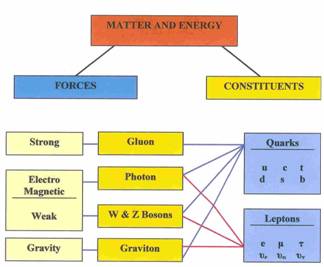
existence and becoming real particles. According to science it is possible that physical quantum particles can randomly pop into existence seemingly out of nowhere. If God is controlling the “quantum dice”, then this means God could cause these subatomic quantum particles to come into existence out of nowhere. This does not contradict the laws of physics in any way. Rather the laws of physics and modern science make clear that subatomic quantum particles popping into existence from out of nowhere is the normal state of the universe, which science has confirmed. And it is entirely possible for this randomness to be controlled by God controlling the “quantum dice”; and the quantum randomness seen has no explanation. Metaphorically speaking, this is a huge hole in the wall of science, which allows for the hand of God to come through into the physical universe, without in any way contradicting science or the known laws of physics. This shows that science actually allows for miracles and the miraculous done by God, without it in any way conflicting with Science or Modern Physics. Modern Physics teaches that elementary particles, of all kinds, can and do randomly pop in and out of existence. This includes photons, which are particles of light. This also includes gravitons, which are theoretical and theoretically instrumental in gravity, as well as gluons, bosons and other force carrying particles.
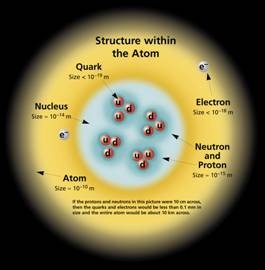
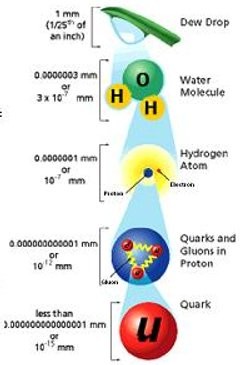
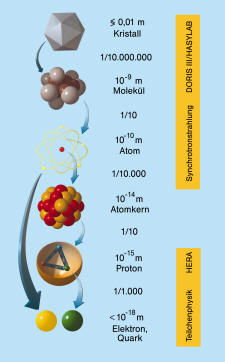
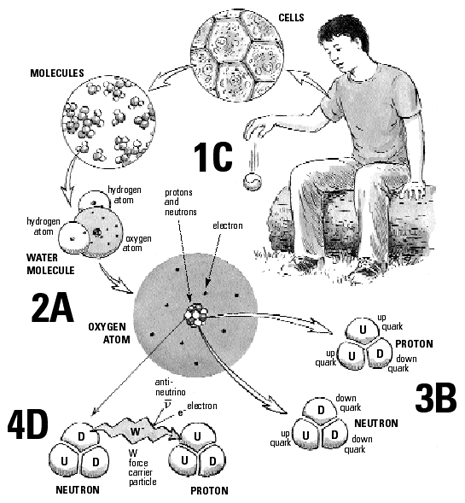
Some force carrying particles are what hold quarks together to form neutrons and protons, and other force particles hold together atoms. All of these particles can pop into existence out of nowhere, seemingly randomly, the universe allows for this, and the universe was created by God intentionally to be the way it is. What are quarks and electrons? They are the particles that are the building blocks of atoms.
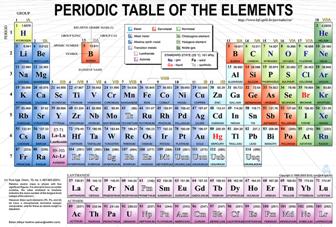
Different types of atoms make up all of the elements of matter, as seen in the periodic table of the elements.
Atoms are the building
blocks of all the matter we see, and our bodies are made of atoms.
This might include things like oil and grain popping into existence out of nowhere: 1 Kings 17:8-16 God provided for 3 years oil and grain, though the land was in a drought with famine. This oil and grain appeared seemingly out of thin air. But another way to put it might be that it appeared out of “seemingly random quantum foam”. And there are many miracles, signs, and wonders in the Bible, done by God, which are similar to this, such as Jesus Christ feeding the multitudes of thousands from a couple fish and a few loaves of bread. Also, there are miraculous healings mentioned many times in the Bible. According to science, our bodies are made up of molecules of atoms, which are made from quarks and electrons and such. Consider the cases of sight being restored to the blind, the healing of the disfigured hand, the healing of lepers, and the healing of all manner of sicknesses; miracles done by Jesus Christ. Control over the “quantum dice” would be one way to explain how sick flesh was instantaneously changed into healthy flesh.
And so this is one way to describe, in modern physics concepts, how God does miracles, signs, and wonders. Though God does do them, whether control of the “quantum dice” of quantum physics is truly and specifically how, or not. But the Bible also says that Holy angels, and Fallen angels, also work miracles, signs and wonders. (Acts 2:22, 5:12, 2 Peter 2:11, Heb 2:4, Matt 24:24, 2 Thes 2:9, Rev 13:2, 14, 16:14) So it could be an accurate description to say that how fallen angels also do miracles, signs, and wonders is because they too somehow have control over the “quantum dice”, though definitely on a more limited scale than God does. The Bible teaches that God is everywhere in the universe, and there is nowhere that He is not. Whereas fallen angels have a set, limited, location for their spirit body, and are only in one place at a time, much like mankind. Under this line of reasoning, God has power, and “quantum power” over everywhere in the universe, but fallen angels only have power or “quantum power” in their immediate location. Also, God has power over the fallen angels’ spirit bodies themselves, as their bodies are part of the creation, whereas fallen angels have no such power over God. It does make some analogous sense that all angels would have powers like God, but limited, for the Bible several times in the Old Testament calls angels the “sons of God”. (Gen 6, Job 1:6, Job 2:1, Psalm 29:1, 89:6)
It may be that the extra-dimensionality of angels is what would make possible
them having limited control over the “quantum dice” in their immediate location. According to String Theory, particles in the 4-dimenional space-time we observe, are the result of vibrations of 1 dimensional strings that exist in an additional 6-7 dimensions, in the scientific sense of the word which (comes to10-11 dimensions total). As such, speaking generally
according to science in principle, it is possible that the extra-dimensionality
of angels would allow for their altering of particles in our 4 dimensional
world, on the subatomic quantum level. As such, their extra-dimensionality, in
the spiritual realm, may be tied directly to their ability to work “miracles,
signs, and wonders”, possibly through being able to determine how the “quantum
dice” fall (on a limited scale in their immediate locality).
When it comes to Holy angels or fallen angels, the Bible describes that they can
cause dreams and Visions, as well as causing the physically miraculous or
miracles. Excepting time perception
manipulation, I also think this “quantum dice” idea explains all varieties and
aspects of Visions quite well, and also dreams. This is because the human brain
also can experience the effects of a fallen angel being able to control the
“quantum dice” (in a limited localized way). Although the effect of quantum mechanical uncertainty in the brain is normally small, if fallen angels can determine how the “quantum dice” fall, then a fallen angel could make the effect quite large and noticeable. Regarding False Visions, all of
our physical senses are dependant on how our brain interprets them. By fallen
angels generating electrical impulses in the brain, and such things like that,
fallen angels would be able to make us “see” things that are not actually in
front of our eyes, and “hear” things that are not there to make any sound,
“feel” things that are not touching our bodies, “smell” things not before our
noses, and “taste” things that are not on our tongues. These things would seem
completely real to all of the bodily senses. And
the electrical impulses that are truly transmitting information about reality
around us could also be blocked out by fallen angels, under this same ability.
Or actual reality could be partially blocked. And either way, false electrical
signals in the brain generated by fallen angels, through manipulation of the
“quantum dice”, could cause a person to experience a False Vision that seemed
entirely physically real, but was not. Besides all of this, there is one more thing which is miraculous that fallen angels do, which modern science allows for in a specific way. That is time perception manipulation. Luke 4:5 “And the devil, taking him up into an high mountain, shewed unto him all the kingdoms of the world in a moment of time.” This case of Satan likely causing Jesus Christ to have a Vision, as mentioned in the Bible, was likely at least hours in less than 1 second. What we are going to cover next is the time perception manipulation abilities of fallen angels, as seen in fallen angelic. I will first be covering the ways time perception manipulation can Not be explained under Modern Science, before I get into the way it can be explained, and Modern Physics allows for this. As the brain of the victim of a False Vision is an integral part of how fallen angels carry out these Visions, and the memories of these attacks are stored in the brain, then the time perception manipulation aspect of these attacks must be explainable in a way that is consistent and not conflicting with the physical human brain and how it functions. And so any explanation of time perception manipulation must be limited and confined to explanations that do not conflict with the science of the human brain. If we were to assume that time perception manipulation involves a compacting or compressing of extensive experiences into a short period of time, then this would require the human brain to handle in one second, somewhere from a hundred to a thousand times more information than the brain usually processes in one second. The brain processes information by the firing of neurons. The only information I could find on neurons firing more rapidly than normal were studies on psychoactive drugs, heroin especially. As people attacked by fallen angels that experience time perception manipulation do not report experiencing a severe heroin-like sensation, this serves as experimental evidence that overly-rapid neuronic firing in the normal passage of time will not work to explain this time perception manipulation. And as such, time perception manipulation does not involve a compacting or compressing of extensive experiences into a short period of time. The only other option is that these experiences actually do take as much time as subjectively perceived by the person having a fallen angelic Vision, though objective time passage for the rest of the world is much shorter. A major example for this may be seen in the theory of general relativity. According to relativity, no matter what speed a person moves, time is perceived to pass at the same rate. However, less time will comparatively pass for an accelerated person than for a (relatively) stationary person. Yet either person will feel time passing at the same rate. It could be argued from a theological standpoint that God designed the human brain to need a consistent flow of actual time in order to function correctly, and designed a universe in which time passage would remain consistent, no matter to what speed a human might accelerate. Because the person’s brain is involved in the process of a Vision, yet their body does not go anywhere, many theoretical physics concepts dealing with time would not work to explain how the brain can experience more time while the body experiences less time.
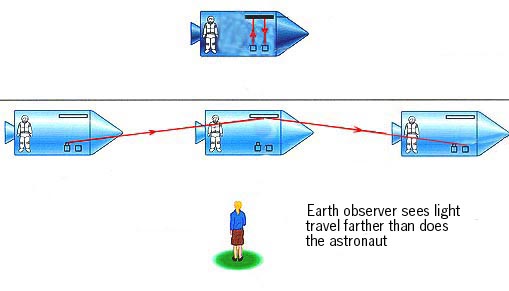
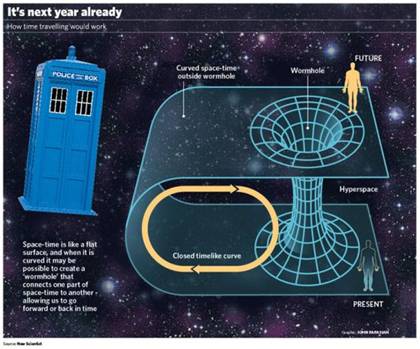
Could general relativity, and time dilation explain how this works? Relativistic Time Dilation would not work, because it would require the body to feel acceleration (or its gravitational equivalent) in comparison to the brain, at over 99% the speed of light. This speed would be necessary to produce a 100 or 1000 seconds to 1 second ratio. This is not what is reported by witnesses of the person under attack's body, that see it does not go anywhere, nor the Biblical account that during Visions people do not go anywhere. So this cannot be the case, aside from the fact that such a thing would likely kill the person. Could time travel gained by travel to the future, and then the past, explain this extra perceived time? There is a type of theoretical wormhole, called a CTC, which was once theorized to be able to be used in this way, if many detailed criteria were met. But according to the current consensus of scientists, a CTC would not work for time travel to the future or past. This manner specifically would involve moving a brain to another location in 4d space-time, spending a real amount of time in that other location moving into the future, and then the brain traveling back in time to the same moment it left. Even if this could work without killing the person, a CTC wormhole still would not work for returning the brain to the past, as a CTC will not work for time travel to the past or future. A CTC wormhole will not work for time travel to the future and past for a brain, or a person, or even for a bowling ball, as they cannot be used for time travel in general. Kip Thorne and Stephen Hawking had an ongoing debate for about 20 years over the subject of time travel into the past, using a CTC wormhole for time travel. The debate, based on their books, seems to have become settled, with Thorne (pro-possibility of time travel) coming to agree with Hawking (anti-possibility of time travel). Here are some highlights: “Perhaps fortunately for our
survival (and that of our mothers), it seems that the laws of physics do not
allow such time travel. There seems to be a Chronology Protection Agency that
makes the world safe for historians by preventing travel into the past. What
seems to happen is that the effects of the uncertainty principle would cause
there to be a large amount of radiation if one traveled into the past. This
radiation would either warp space-time so much that it would not be possible to
go back in time, or it would cause space-time to come to an end in a singularity
like the big bang and the big crunch. Either way, our past would be safe from
evil-minded persons. The Chronology Protection Hypothesis is supported by some
recent calculations that I and other people have done. But the best evidence we
have that time travel is not possible, and never will be, is that we have not
been invaded by hordes of tourists from the future.” “Hawking suspects that the
growing beams of vacuum fluctuations is nature’s way of enforcing chronology
protection: Whenever one tries to make a time machine, and no matter what kind
of device one uses in one’s attempt (a wormhole, a spinning cylinder, a “cosmic
string”, or whatever), just before one’s device becomes a time machine, a beam
of vacuum fluctuations will circulate through the device and destroy it. Hawking
seems ready to bet heavily on this outcome. I am not willing to take the other
side in such a bet. I do enjoy taking bets with Hawking, but only bets that I
have a reasonable chance of winning. My strong gut feeling is that I would lose
this one. My own calculations with Kim, and unpublished calculations that Eanna
Flanagan (a student of mine) has done more recently, suggest to me that Hawking
is likely to be right. Every time machine is likely to self-destruct (by means
of circulating vacuum fluctuations) at the moment one tries to activate it.” That was all from 1994, but a more recent quote from 2001 shows the issue has generally been settled: “… Since the
sum-over-histories calculations in these backgrounds are mathematically
equivalent, one can conclude that the probability of these backgrounds goes to
zero as they approach the warping needed for time loops. In other words, the
probability of having sufficient warping for a time machine is zero. This
supports what I have called the Chronology
Protection Conjecture: that the laws of physics conspire to prevent time travel
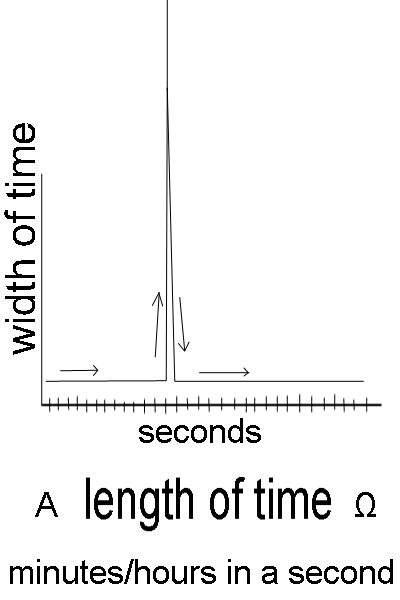
by macroscopic objects. One problem with time travel to the past between 2 locations in 4d space-time, is that, put simply, electromagnetic vacuum fluctuations would build up traveling in a loop from the present to the past, an infinite loop, and this would destroy any pathway from the present to the past. Stephen Hawking and Kip Thorne have said, CTC wormholes won’t work for time travel. As such, this is also not a possibility for time perception manipulation during a fallen angel attack, and it can summarily be concluded that peoples’ brains do not go anywhere, or time travel. Time gained by traveling to the future, and then the past, is not allowed by physics in any way that would fit this time perception manipulation scenario seen in a fallen angelic Vision. Biblically, this can be understood in that God created the universe so as to not allow time travel into the past. God controls both sides of the wormhole, and it is God who would make it so electromagnetic vacuum fluctuations in a loop from the wormhole mouths would destroy the wormhole before it could allow for any possible time travel. God created time, as did Jesus Christ, as all things were created through Him. Jesus Christ says: As such God has complete authority over time, and simply does not allow time travel to the past, or the future and then the past again. None of these theories mentioned will work as an explanation for time perception manipulation caused by fallen angels during False Visions. So then what is going on? The key verse is Luke 4:5 This verse does not describe time travel to the past. In contrast, this verse describes a long period of time passing during a second, or less than a second. Or another way to say this is that some extra time was perceptually gained by the person, more than the objective passage of time that God controls.This verse describes a long period of time passing during a second, or less than a second. Or another way to say this is that some extra time was perceptually gained by the person, more than the objective passage of time that God controls. So how would a fallen angel do this? How might this work? The answer is that there is simply more to the dimension of time than we normally think of there being. I believe the Bible sets precedence for this concept, and this is how I would interpret Joshua’s Long Day. Josh 10:12-14 I have read several theories to explain how this worked, but here is mine: When God made the dimension of time, He made it to have both its flow in length, as we normally perceive, and draw as a line, but also to have a width to it, at right angles to its length. This width is normally small and tight like a string. But the width of time is like a stretchy material, like a rubber band, and so if God wants to, God can stretch out the width of time. The width of time is not affected by the 3 dimensions of space, or things like gravity or speed. The length of time is what is referred to in “space-time”, but the width of time exists unaffected by the things that would normally affect the length of time. In other words, the width of time works like a 2nd dimension to time. In Joshua’s Long Day, it was the width of time that God stretched out, around the surface of the earth, and for the people on the earth. As such the people on earth experienced long time passage in the width of time, during what was a brief moment in the length of time. I believe that according to physics this is possible. Although the concept of time having a 2nd dimension of “width” seems to be in its infancy, there is some information to be found on it. The concept which parallels the “width” of time in modern theoretical physics is the concept of “imaginary time”: “…One of these is that it is
easier to do the sum if one deals with histories in what is called imaginary
time rather than in ordinary, real time. Imaginary time is a difficult concept
to grasp, and it is probably the one that has caused the greatest problems for
the readers of my book. I have also been criticized fiercely by philosophers for
using imaginary time. How can
imaginary time have anything to do with the real universe? Imaginary time is
already a commonplace of science fiction. But it
is more than science fiction or a mathematical trick. It is something that
shapes the universe we live in. Though it is a newer concept, it seems that imaginary time shapes the universe we live in. According to physics, what is it like? “You can think of
ordinary, real time as a horizontal line, going from left to right. Early times
are on the left, and late times are on the right. But you can also consider
another direction of time, up and down the page. This is the so-called imaginary
direction of time, at right angles to real time. “When one tried to unify
gravity with quantum mechanics, one had to introduce the idea of “imaginary”
time. Imaginary time is indistinguishable from directions in space. If one can
go north, one can turn around and head south; equally, if one can go forward in
imaginary time, one out to be able to turn round and go backward. This
means that there can be no important difference between the forward and backward
directions of imaginary time. On the other hand, when one looks at “real” time,
there’s a very big difference between the forward and backward directions, as we
all know.” Imaginary time does not follow the forward direction of time, but instead forms a closed loop, in which there is no distinguishable forward or backward direction. This concept seems to parallel a stretchy width to time very well. A person experiencing imaginary time could gain time, going around a closed loop on the width of time, and ending up where they started. This would allow time to be gained, and experienced, by the person, without that person moving forward on the length of time, save a moment. Could the science theory of Imaginary Time, or concept of a Width to Time, explain time perception manipulation in False Visions caused by fallen angels? …Yes. As I have mentioned before, the Bible calls the angels the “sons of God” in several places, and this may relate to that angels can do many of the same things that God can do, but on a more limited and local basis. For instance, God can perform miracles, signs and wonders, and Joshua’s Long Day was one of these miraculous events. If this analogy holds true in this case, as it has in other cases, then it would make sense that fallen angels may also be able to stretch out the width of time on a limited local basis. The length of time God keeps all authority over, and fallen angels cannot travel it nor stretch it out. But during a Vision the additional time perceived would be from fallen angels stretching out the width of time (not the length of time). In fallen angelic Vision
experiences, this could be visualized as a fallen angel stretching out the width
of time around the brain of the person under attack. The person’s brain does Not
leave their body, nor move forwards and backwards along the length of time. But
the person does experience a gain of time from the period in which the width of
time is stretched out around their brain. This allows for a gain of perceived
passage of time in a Vision, and would allow for a couple minutes to or even a
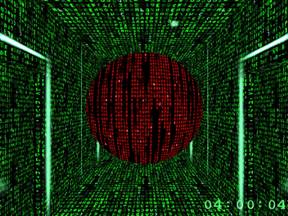
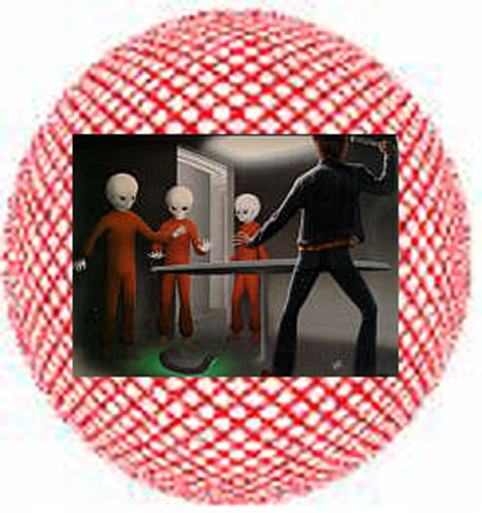
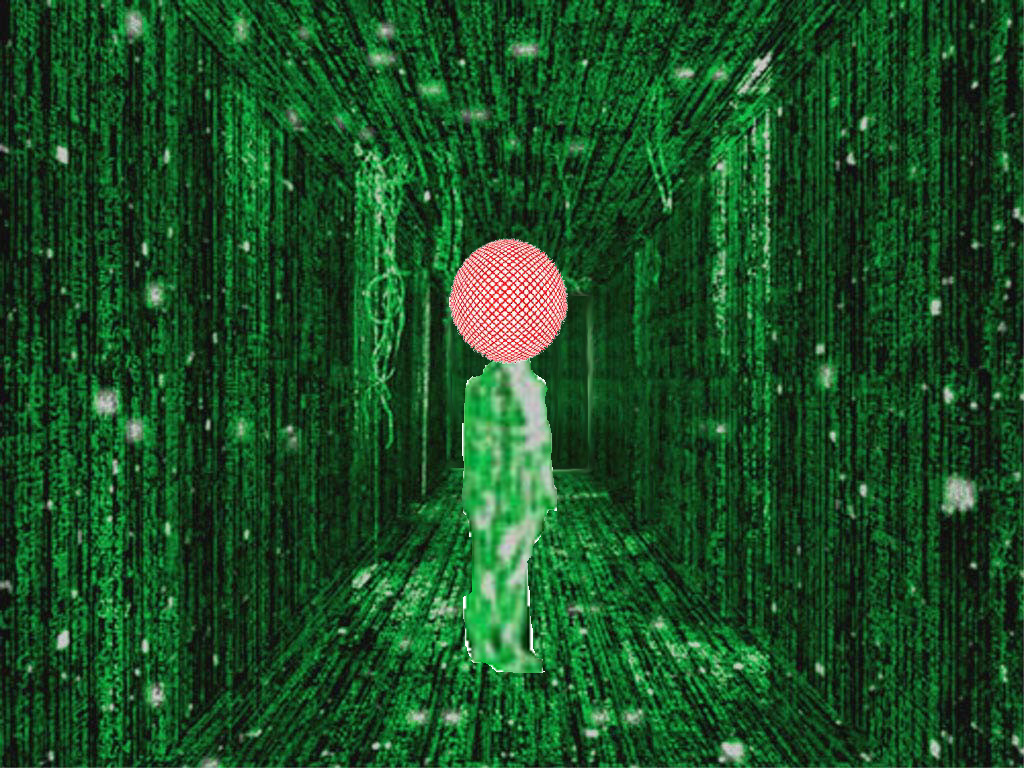
couple hours to be perceived to pass in a moment, or second. This scenario would allow the brain to function at its normal speed, with decision making processes working as they normally do in the brain-mind-soul-spirit connection. This would also allow for memories to be stored in the brain according to the normal way the brain functions. And so this is how I would explain fallen angels accomplish time perception manipulation during Visions. Modern Physics seems to somewhat allow for this, especially angels might be able to do this under the explanation of if they were extra-dimensional in 6-7 extra dimensions, they might be able to access a second dimension of time as well. In any case, this explanation of stretching the width of time around the brain of the person would work to explain time perception manipulation in Visions. I find a good analogy to conceptualize an extra dimension or dimensions is the green code in the Matrix movie. Like the agents in the Matrix movie, fallen angels can alter the “code” (“quantum dice”) to change what is there and alter the green code inside a person’s mind, to change what the person perceives, through their brain. As such I often try to represent the aspects of Fallen angelic False Visions using Matrix imagery. I use a red sphere of code to represent the invisible extra-dimensional or spiritual realm fallen angel. As an example, this is a close up of a fallen-angel-caused vision of an “alien abduction”. Remember that the entire vision, all 3 aliens, and the setting, are all caused by 1 fallen angel. In this example, the red ball below contains a person standing in a room with 3 aliens, near a table, in a defensive posture against the aliens. That is how the person having this Vision experiences themself to be, and it seems real to them, though a Vision.
What this represents is that because of a fallen angel, the neurons in the person's brain are firing in such as way that their perceptions have been altered. As the person perceives their surroundings through their brain, which is the hub and gateway to all the physical senses, the true green reality has been blocked out either fully or partially, and the person perceives what is going on in the red sphere, which is the fallen angel attacking. Their brain being able to send signals of sensing the green reality around them has been blocked, and instead the deceptive red signals of the fallen angel is what is getting through to their brain. In the most extreme case, this can mean the person may perceived being touched, when they are not, smell things, see things, etc. which seem entirely physically real, but are not. These physically sensations can be of things which are external to the body, or internal to the body (such as John's stomach ache in Revelation). Because of brain-sensory-hacking abilities of fallen angels seen in False Visions, which can seem completely physical, it can be difficult to be able to tell with certainty that an actual purely physical manifestation of a fallen angel has occurred. Perhaps one example is that of fallen angels manifesting as UFOs (or whatever) in which pictures or video-recording have been taken. But keep in mind, when fallen angels do physically manifest, it may only be on a very limited and partial basis. One example is the audio-recordings made of ghosts, which if not hoaxes, only show a physical manifestation of the air vibrating so as to produce a recordable sound. That is all that could be proven to have occurred, at most, when nothing was taken along the lines of a picture. Even at that, it is possible that a physical manifestation in some cases was limited to only a direct altering of the film or recording device, whether pictures of ghosts or UFOs, video film, or audio recordings. In conclusion, Science and Modern Physics seems to allow for the miraculous and miracles, whether caused by God, Holy angels or fallen angels. For Christians, the Bible does establish the kinds of things that fallen angels can do. Taking the Bible as the authoritative Word of God, on faith, there really is no need to question that fallen angels have these abilities. The Bible says fallen angels have these abilities, both of whatever degree of physical effects, and causing False Visions and dreams. Bible-believing Christians should be able to accept that, whether modern science has caught up to the Truth of the Word of God, or not. But the hope with this piece is that you can understand that Science and the Bible do not conflict, as science actually allows for the miraculous to occur, as is recorded in the Bible and seen in miracles God still works today. And as also seen in the false signs and wonders that happen today, caused by fallen angels. Theories in Science are always changing, in a progressive accumulation of knowledge: they are not truth. Where the Bible and science seem to contradict, I believe the Bible should always be deferred to as Correct and Truth, no matter what science teaches or scientists say. I’ve touched on topics involved with big bang theory, quantum mechanics, black holes, worm holes, extra dimensions, and string theory. But I agree with what Russell Grigg, from CMI-Australia has to say on this: “It has truly been said that
Christians married in their thinking to today’s science (e.g. big bang, ten
dimensions, etc.) will be widowed tomorrow.” That being said, I’m not entirely convinced about any of these theoretical science theories, and my intent here has not been to convince anyone of them. But rather, the aim of this was to use Modern Physics theories to show that science does not contradict or in any way disallow what that Bible teaches is true. The main point of doing this is to show that science does not preclude the existence of miracles of God and of holy angels, and also the false miraculous done by fallen angels. But rather I believe modern science actually completely allows for miracles, and for fallen angels, and their Biblically described abilities. Rather than prove this seemingly supernatural activity is impossible, science actually completely allows for all of this to be possible... Modern physics shows that God created the universe to leave room for the miraculous to occur, without violating the laws of physics that He set up and maintains. In any case, God is infinitely dimensional, without any question, having created all dimensions and everything in them, and as we know, God, in His three persons, can do anything and is All-powerful. A fallen angel is more powerful than a human. But Jesus Christ is the Son of God, fully God and fully man, and also infinitely dimensional. So Jesus Christ is more powerful than any fallen angel, and even more powerful than all fallen angels combined. This is just another way of looking at what we already know, that Jesus Christ is seated at the right hand of God, with all power, above every other power, principality, authority, above every angel, Holy or fallen. Angels can only be in one place
at once, as we see in Daniel 10. And angels were created by God, as Genesis says, But Jesus Christ is the fullness of the Godhead in human form, and Jesus Christ said “before Abraham was, I AM”, and John tells us “All things were made by him; and without him was not any thing made that was made”, showing Jesus Christ’s infinite dimensionality as the Son of God. And the Bible tells us in Acts
4:10-12, And we see this in that supernatural harassment and attacks stop in the name and authority of Jesus Christ. Jesus Christ can and does help those who call out to Him for His help, who have faith in Him and believe upon the power of His Name. So Jesus Christ is more powerful than fallen angels, in whatever form they take, no matter how powerful they seem, Jesus Christ is more powerful.
|